How to track the Bristol Stool Chart for gut transit speed and motility
A clinical guide to classifying stool form, stool color, urgency, and evacuation completeness to diagnose colonic transit disorders.
The Bristol Stool Chart classifies bowel movements into 7 distinct types based on colon transit duration. Types 1 and 2 indicate slow transit and dehydration. Types 3 and 4 reflect healthy transit speed. Types 5, 6, and 7 indicate rapid transit and inadequate water absorption. Evaluating stool form alongside urgency, volume, and evacuation completeness shows whether your symptoms are caused by colonic dysmotility, visceral hypersensitivity, or pelvic floor dysfunction.
Summary of steps in this guide
- 1Classify your stool type using Bristol Types 1 through 7
Examine stool consistency before flushing. Categorize hard lumps as Types 1 to 2, formed sausages as Types 3 to 4, and mushy liquid as Types 5 to 7.
- 2Differentiate true movements from tenesmus urges
Record false alarm urges separately from actual evacuations to give doctors clear markers for rectal hypersensitivity.
- 3Record stool color and volume
Check for abnormal stool colors (black, pale, red, yellow) and estimate volume from very small to very large.
- 4Rate evacuation completeness and urgency
Rate the sensation of rectal emptying on a 1 to 5 scale and score urgency from 1 (mild) to 5 (extreme emergency).
- 5Calculate your gut motility score with variance penalties
Measure your average distance from optimal Bristol 3.5, and penalize high volatility to detect alternating IBS-M.
The Bristol Stool Form Scale is the primary visual assessment tool used in gastroenterology clinics worldwide. Developed in 1997 by Dr. Ken Heaton at the University of Bristol, it correlates the visual appearance of human stool with the amount of time it spent inside the colon.
When food takes too long to travel through the large intestine, the colon absorbs excess water, turning stool into hard, dry pellets. When food travels too fast, the colon does not have enough time to absorb water, resulting in loose, watery diarrhea.
Tracking these visual forms systematically transforms subjective bathroom complaints into measurable medical data.
Understanding the 7 Bristol Stool types
Type 1: Separate hard lumps, like nuts
- Colonic transit time: Typically 80 to 100 hours or longer.
- Clinical meaning: Severe constipation. Stool has lost almost all moisture, making passage painful and abrasive.
Type 2: Sausage-shaped, but lumpy
- Colonic transit time: Typically 60 to 80 hours.
- Clinical meaning: Mild constipation. The stool lumps have bonded together, but water content remains low. Passage frequently requires significant straining.
Type 3: Like a sausage, but with surface cracks
- Colonic transit time: Roughly 40 to 60 hours.
- Clinical meaning: Normal stool form. Easy to pass, with adequate hydration and dietary fiber.
Type 4: Like a sausage or snake, smooth and soft
- Colonic transit time: Roughly 30 to 40 hours.
- Clinical meaning: The clinical gold standard. Stool passes effortlessly in a single piece and leaves little to no residue on toilet paper.
Type 5: Soft blobs with clear-cut edges
- Colonic transit time: Roughly 20 to 30 hours.
- Clinical meaning: Borderline loose stool. Common in individuals with multiple bowel movements per day or during mild dietary shifts.
Type 6: Fluffy pieces with ragged edges, a mushy consistency
- Colonic transit time: Roughly 10 to 20 hours.
- Clinical meaning: Mild diarrhea. Indicates rapid colonic transit caused by stress, dietary irritants, bacterial fermentation, or osmotic laxatives.
Type 7: Watery, no solid pieces, entirely liquid
- Colonic transit time: Under 10 hours.
- Clinical meaning: Severe diarrhea. Water absorption has failed completely. Prolonged episodes risk dehydration and electrolyte imbalance.
The 5-step daily motility tracking protocol
Step 1: Classify your stool type immediately
Check your stool form before flushing. Classify the consistency as an integer from 1 to 7.
Do not wait until the evening to record your morning bowel movement. Recall error will cause you to underestimate mild variations and forget small visits.
Step 2: Differentiate true movements from tenesmus urges
If you rush to the bathroom feeling severe urgency but only pass gas or a tiny drop of mucus, log this as an urge event rather than an empty bowel movement.
Tenesmus is a common feature of rectal hypersensitivity and pelvic floor dysfunction. Your doctor needs to know how many false alarms you experience relative to completed evacuations.
Step 3: Record stool color and volume
Normal stool color ranges from light to dark brown due to bilirubin breakdown products.
- Black, tarry stool: An urgent red flag that can signify bleeding in the stomach or upper intestine.
- Red stool: Indicates lower gastrointestinal bleeding or dietary dyes (like beets).
- Pale or clay-colored stool: Suggests biliary duct obstruction.
- Yellow stool: Associated with malabsorption of dietary fats or rapid transit.
Estimate volume using five simple tiers: very small, small, medium, large, or very large.
Step 4: Rate evacuation completeness and urgency
Record rectal sensation after every visit:
- Completeness: Rate from 1 (felt completely blocked or incomplete) to 5 (felt fully emptied).
- Urgency: Rate from 1 (no rush) to 5 (had to drop everything immediately).
A patient who passes Bristol Type 4 stool with an urgency score of 5 and a completeness score of 1 has a very different condition than a patient who passes Bristol Type 4 stool with an urgency of 1 and completeness of 5.
Step 5: Calculate your gut motility score with variance penalties
To assess your overall health, measure the distance between your average Bristol score and optimal Bristol 3.5.
However, average numbers can be misleading. A patient alternating between Type 1 (constipation) and Type 7 (diarrhea) will have an average score of 4.0, which appears healthy on paper.
To catch alternating IBS-M, calculate the standard deviation of your Bristol scores and subtract it as a penalty from your health index.
How GutLog 1.5.6 automates motility tracking
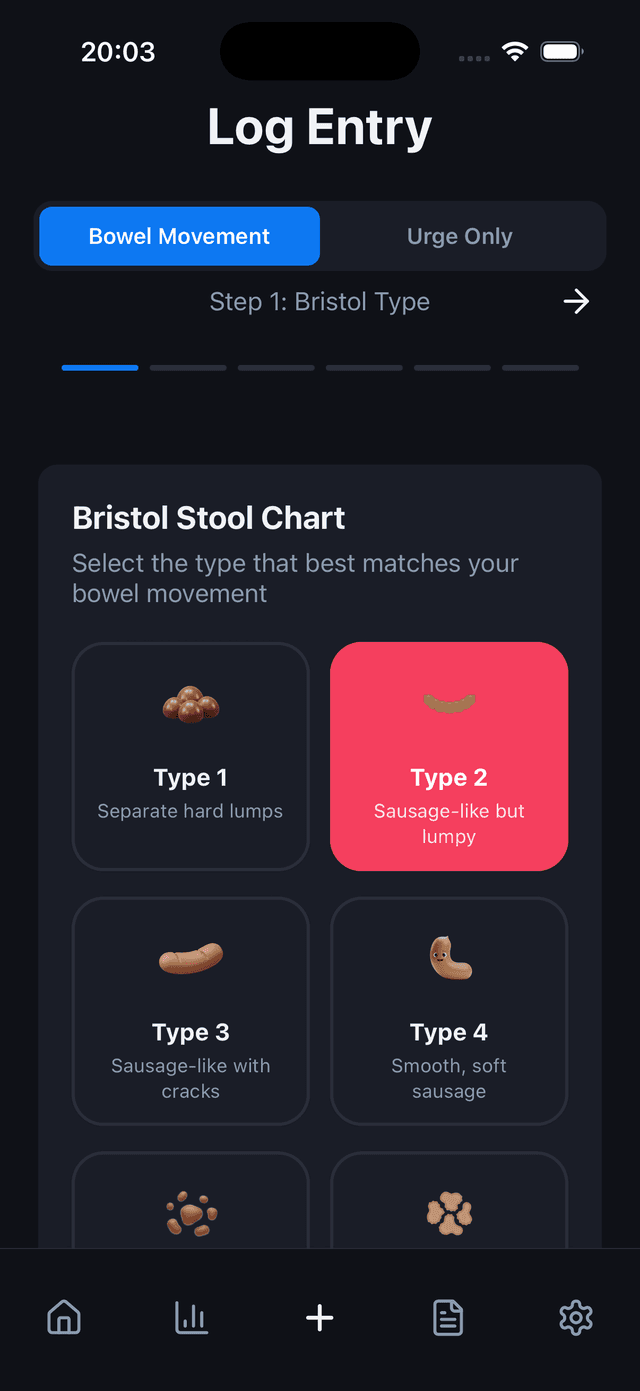
GutLog makes recording the Bristol scale fast and clinically accurate:
- 30-second tap logging. Visual illustrations for Bristol Types 1 through 7 allow you to log an entry in seconds.
- Dedicated urge tracking. Log tenesmus false alarms with one tap to track rectal hypersensitivity.
- Stool color presets and custom picker. Choose from 7 clinical color presets or select an exact hex tone.
- Gut Health Score engine. GutLog calculates your Gut Health Score daily using a 40% weighted Bristol distance formula. It applies a standard deviation penalty to detect and reflect IBS-M alternating patterns accurately.
- 60-day calendar heatmap. View your daily bowel movements color-coded by Bristol type on an interactive monthly calendar.
Automate this protocol with GutLog 1.5.6
Tracking symptoms and calculating statistical correlations on paper or spreadsheets takes hours, introduces memory bias, and cannot detect multi-hour transit delays.
GutLog calculates your daily Gut Health Score using a 40% weighted Bristol index with standard deviation penalties for alternating IBS-M patterns.
- Evaluates 6 digestion lag windows (2, 4, 8, 12, 24, 36 hours)
- Calculates Poisson arrival baseline rates and lift scores
- Generates doctor-ready A4 PDF reports in one tap
- Operates 100% on-device with zero cloud health tracking
Frequently asked questions
What is the ideal Bristol Stool type?
Bristol Type 3 (sausage with cracks) and Type 4 (smooth, soft snake) represent normal colonic transit. They pass easily without straining and indicate balanced fiber intake and hydration.
Can you have both constipation and diarrhea in the same day?
Yes. This pattern is common in IBS-M (mixed type). It often occurs when hard stool (Type 1 or 2) causes a partial blockage in the rectum, and liquid stool from higher in the colon bypasses the obstruction.
What does yellow or pale stool indicate?
Pale or clay-colored stool suggests reduced bile output from the gallbladder or liver. Bright yellow stool often indicates rapid transit, where bile does not have sufficient time to break down into brown stercobilin.
Start tracking your digestive health today
Download GutLog for iPhone. Free to start, no account required, completely private.
Download on the App Store