How to identify delayed IBS food triggers
A step-by-step clinical protocol for isolating delayed food triggers using multi-hour lag windows and Poisson baseline lift calculations.
Digestive reactions rarely happen immediately. Food travels through the stomach and small intestine before reaching the colon, producing symptoms 2 to 36 hours later. Finding your true triggers requires logging meals with time offsets, testing multi-hour correlation windows, and calculating symptom rates against your baseline instead of blaming the last meal you ate.
Summary of steps in this guide
- 1Log meals with accurate time offsets
Record what you ate along with the estimated time offset (immediate, 2 to 6 hours ago, 6 to 12 hours ago, or 12+ hours ago).
- 2Classify bowel movements by Bristol type and pain score
Record every bowel event on the Bristol Stool Scale, rating abdominal pain from 0 to 10 and urgency from 1 to 5.
- 3Stop blaming the last meal
Colonic fermentation takes 6 to 24 hours. The meal you just ate often triggers a gastrocolic reflex that empties yesterday's digested food.
- 4Calculate your baseline flare rate
Measure your normal daily symptom frequency using an arrival model so random flares do not skew your results.
- 5Isolate confirmed triggers with lift calculations
Compare the symptom probability after eating a specific food against your baseline rate. A lift above 1.4 marks a probable trigger.
Most people with irritable bowel syndrome struggle to isolate their trigger foods for years. They cut out dairy, feel better for two days, eat a salad, experience severe cramping, and assume lettuce is the culprit.
This trial-and-error cycle fails because the human digestive tract is not an instant pipe.
Understanding how food moves through your body, and using a systematic lag window protocol, is the only reliable way to pinpoint what hurts your stomach.
Why you cannot trust your immediate reaction
When you eat a meal, your stomach stretches and releases hormones that stimulate contractions in your large intestine. This biological reaction is the gastrocolic reflex.
If you eat a bowl of soup at noon and rush to the restroom twenty minutes later with diarrhea, the soup did not cause the diarrhea. The soup simply signaled your colon to evacuate contents that had been fermenting there for 12 to 24 hours.
If you log the soup as a trigger, your journal becomes misleading. True colonic food triggers, like poorly absorbed carbohydrates, require hours of microbial fermentation before producing excess gas, water retention, and visceral pain.
The 5-step protocol to isolate delayed triggers
Step 1: Log meals with accurate time offsets
Tracking what you eat is useless if your timestamps are wrong. When logging meals, record when the food was actually consumed. If you eat breakfast at 8:00 AM and log it at 1:00 PM, adjust the entry backwards by 5 hours.
Without retroactive time adjustments, your analysis will correlate morning symptoms with lunch rather than breakfast.
Step 2: Classify bowel movements by Bristol type and pain score
A flare-up is not a vague feeling. Define abnormal outcomes using objective clinical thresholds:
- Bristol Stool Scale value of 1 or 2 (constipation)
- Bristol Stool Scale value of 5, 6, or 7 (loose stool or diarrhea)
- Abdominal pain rating of 5 or higher on a 0 to 10 scale
- Urgency rating of 4 or 5 on a 1 to 5 scale
- Presence of severe symptoms such as cramping, bloating, or nausea
If a bowel movement falls into Bristol Type 3 or 4 with minimal pain and low urgency, it counts as normal.
Step 3: Stop blaming the last meal
Evaluate every food across multiple digestion windows:
- 2 to 4 hours: Rapid transit, gastric dumping, or osmotic water shifts
- 4 to 8 hours: Small intestinal transit and early carbohydrate breakdown
- 8 to 18 hours: Proximal colon fermentation and gas expansion
- 18 to 36 hours: Distal colon transit and water absorption issues
Testing these individual windows reveals the exact timeline where a factor produces abnormal outcomes.
Step 4: Calculate your baseline flare rate
If you experience diarrhea on 30% of your days, any food you eat frequently will appear to precede diarrhea simply by random chance.
To fix this, calculate your baseline probability. Measure your total hours tracked, count your abnormal outcomes, and determine the background flare rate per hour.
Step 5: Isolate confirmed triggers with lift calculations
Divide the flare rate after consuming a specific food by your baseline flare rate. This ratio is your lift:
- Lift above 1.4: The food increases your symptom risk by at least 40%. It is a probable trigger.
- Lift between 0.65 and 1.4: Neutral. The food has no measurable impact on your symptoms.
- Lift below 0.65: Protective. Abnormal outcomes occur significantly less often after this factor.
How GutLog automates this protocol
Manual calculation of Poisson baseline rates across 6 time windows is impractical on paper. GutLog 1.5.6 handles the mathematics automatically on your iPhone:
- Context offset selector. When you log a meal, choose whether it happened now, 2 to 6 hours ago, 6 to 12 hours ago, or 12+ hours ago. The app shifts timestamps automatically.
- Multi-window testing. GutLog evaluates every factor across 2, 4, 8, 12, 24, and 36 hours to find the window with the strongest symptom signal.
- Four-hour deduplication. Repeated logs from the same meal are collapsed to prevent double-counting.
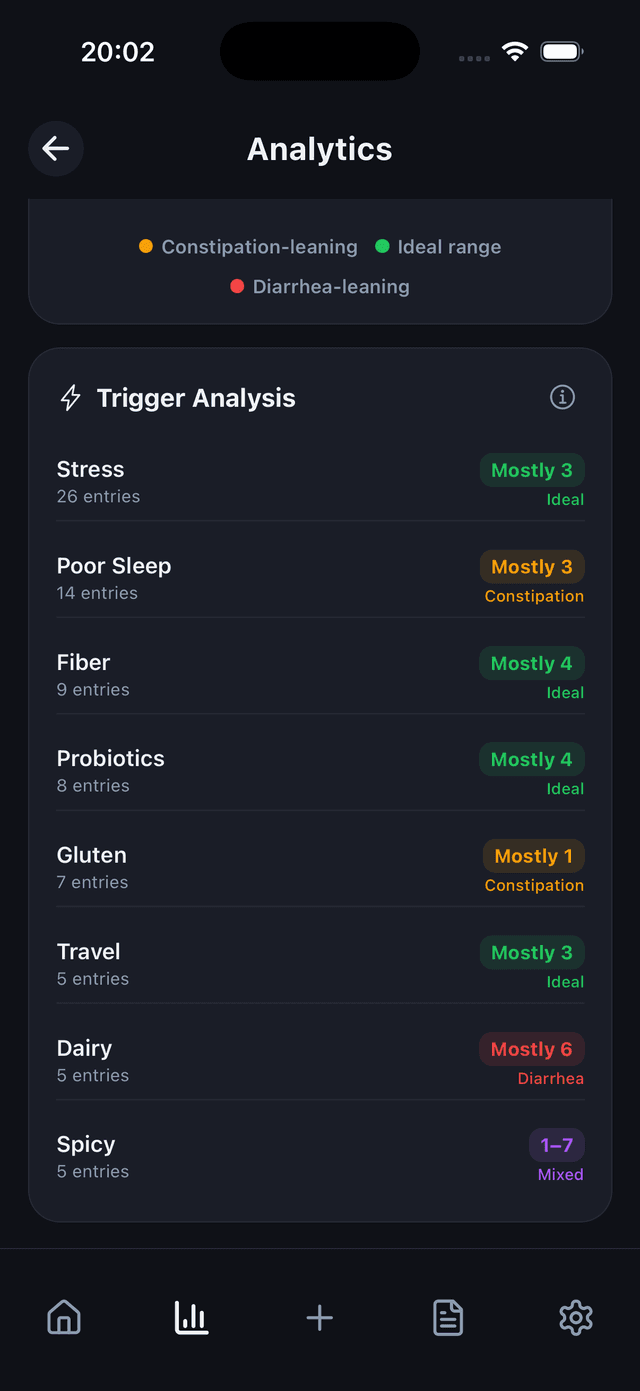
- My Triggers dashboard. Once you reach 20 logs, GutLog ranks your personal triggers and safe foods, displaying hit rates, lift percentages, and typical lag windows.
- Smart trigger warnings. When you log a factor in GutLog 1.5.6, the app checks historical data and alerts you if that item previously correlated with severe symptoms.
Automate this protocol with GutLog 1.5.6
Tracking symptoms and calculating statistical correlations on paper or spreadsheets takes hours, introduces memory bias, and cannot detect multi-hour transit delays.
GutLog tests 6 distinct time windows (2, 4, 8, 12, 24, and 36 hours) for every food tag, using a Poisson arrival model to measure true lift over baseline.
- Evaluates 6 digestion lag windows (2, 4, 8, 12, 24, 36 hours)
- Calculates Poisson arrival baseline rates and lift scores
- Generates doctor-ready A4 PDF reports in one tap
- Operates 100% on-device with zero cloud health tracking
Frequently asked questions
How long after eating does an IBS flare-up happen?
Most food-related IBS symptoms peak between 4 and 24 hours after eating. While the gastrocolic reflex can cause an urge to use the restroom within 30 minutes of eating, the actual stool changes and fermentation cramps stem from meals eaten earlier.
Why is paper food journaling ineffective for finding triggers?
Paper journals suffer from availability bias. People blame whatever food they ate right before a flare-up, ignoring ingredients consumed 12 to 24 hours earlier. Paper logs also cannot calculate mathematical baseline rates or adjust for overlapping meals.
How many logs do you need to confirm an IBS trigger?
Statistically reliable correlation requires at least 20 total logged bowel entries and at least 5 separate occurrences of the suspected food factor.
Start tracking your digestive health today
Download GutLog for iPhone. Free to start, no account required, completely private.
Download on the App Store