How to run a 3-phase elimination diet protocol without losing track
A structured guide to the baseline, elimination, and reintroduction phases of a low-FODMAP diet to isolate food intolerances.
An elimination diet is a medical diagnostic protocol, not a permanent eating plan. It consists of three strict phases: a 7-day baseline observation period on your normal diet, a 14-day elimination phase to reduce gut inflammation, and a structured challenge phase testing one food subgroup every 3 days. Testing foods without baseline tracking makes it impossible to isolate true triggers from baseline symptom noise.
Summary of steps in this guide
- 1Track a 7-day baseline on your regular diet
Record symptoms before removing any food. You cannot measure improvement without knowing your baseline pain and stool frequencies.
- 2Enter the strict 14-day elimination phase
Cut high-FODMAP, gluten, or dairy foods entirely for two weeks until your digestive tract stabilizes.
- 3Confirm symptom reduction before reintroduction
Check that bloating, abdominal pain, and stool irregularities have improved by at least 50% before challenging foods.
- 4Test challenge food groups with 3-day washout intervals
Test one specific carbohydrate subgroup (such as fructose, lactose, or sorbitol) for three days, followed by a three-day rest period.
- 5Calculate symptom deltas to separate triggers from safe foods
Compare challenge day symptom scores against elimination baseline scores to identify true intolerances.
Many people start an elimination diet by reading a list of forbidden foods online and clearing out their refrigerator. Two weeks later, they feel confused, frustrated, and terrified of eating out.
The common mistake is treating an elimination diet like a regular weight-loss diet.
An elimination protocol is a scientific experiment. If you skip the baseline phase, rush the reintroduction steps, or fail to record your daily stool metrics, you will eliminate healthy foods unnecessarily.
The structure of the 3-phase elimination protocol
A clinical elimination protocol must follow three sequential stages:
Phase 1: The 7-day baseline
Before you change a single ingredient in your diet, spend seven days logging your normal eating habits and bowel movements.
This baseline provides your control data:
- Average bowel movements per day
- Standard deviation of your Bristol stool score
- Average daily pain rating (0 to 10)
- Daily bloating and cramping frequency
If you skip Phase 1, you will have no objective proof that the elimination phase produced genuine improvement.
Phase 2: The 14-day elimination phase
During this period, you remove suspected food categories completely. Common protocols include:
- Low-FODMAP: Removes fermentable oligosaccharides, disaccharides, monosaccharides, and polyols
- Dairy-Free: Removes lactose and casein
- Gluten-Free: Removes wheat, rye, and barley
Your gut lining and microbial activity typically stabilize within 10 to 14 days. Watch for a measurable drop in abdominal pain, gas, and stool urgency.
Do not move to Phase 3 until your digestive symptoms have resolved or significantly decreased. If symptoms persist after 4 weeks of strict elimination, your issues may not be dietary. Consult your gastroenterologist to evaluate other conditions like SIBO, bile acid diarrhea, or motility disorders.
Phase 3: The structured reintroduction challenge
This is where you identify your exact trigger thresholds. Choose one FODMAP subgroup at a time:
- Lactose: Test cow milk (1/4 cup on day 1, 1/2 cup on day 2, 1 cup on day 3).
- Fructose: Test honey or mango.
- Sorbitol: Test avocado or blackberries.
- Fructans (Garlic/Onion): Test garlic clove or onion slices.
- GOS (Galacto-oligosaccharides): Test canned lentils or almonds.
Follow the 3-day challenge rule:
- Day 1: Consume a small portion of the test food with a safe meal.
- Day 2: If no reaction occurs, consume a medium portion.
- Day 3: If no reaction occurs, consume a full portion.
- Days 4 to 6: Stop eating the test food completely. Return to the strict elimination diet for a 3-day washout period.
The washout period is mandatory. Delayed gut fermentation reactions can take 24 to 48 hours to manifest. If you begin testing a second food immediately, a delayed reaction from the first food will be blamed on the second food.
How GutLog 1.5.6 guides you through the protocol
Tracking multi-week protocols with spreadsheets is prone to error. GutLog 1.5.6 includes an integrated elimination protocol stepper:
- Active diet tracking. Select Low FODMAP, Gluten-Free, Dairy-Free, or a Custom diet in
app/active-diet.tsx. - Three-phase stepper. GutLog automatically tracks your progress through Phase 1 (7-day baseline), Phase 2 (14-day elimination), and Phase 3 (reintroduction).
- 2x2 challenge grid. View your challenge food groups with step-by-step portion instructions, reaction timers, and washout countdowns.
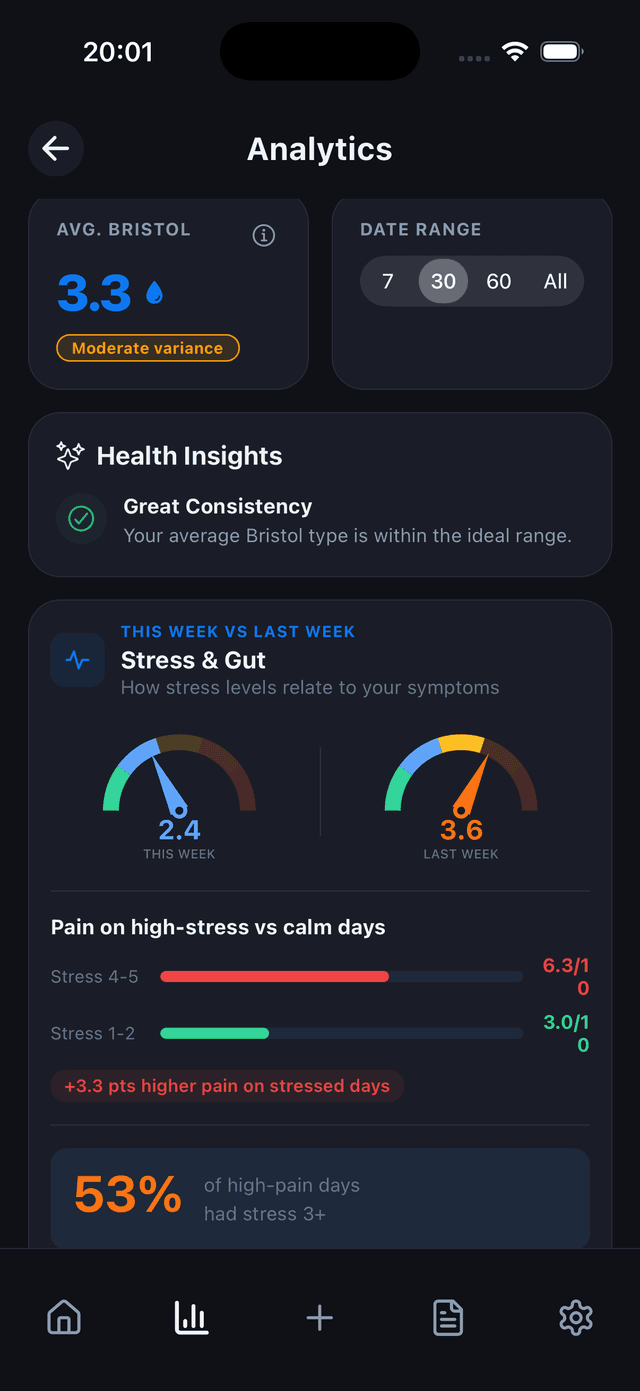
- Diet impact analysis. The app graphs your 30-day pain trend with a vertical marker placed on the exact day you started the diet. It calculates symptom deltas for pain, bloating, and urgency to prove whether the diet worked.
- Remaining irritant identification. As you reintroduce foods, GutLog separates confirmed safe ingredients from proven irritants so you can expand your diet safely.
Automate this protocol with GutLog 1.5.6
Tracking symptoms and calculating statistical correlations on paper or spreadsheets takes hours, introduces memory bias, and cannot detect multi-hour transit delays.
GutLog tracks your 3-phase elimination protocol with a step-by-step reintroduction challenge grid and a 30-day diet impact pain curve.
- Evaluates 6 digestion lag windows (2, 4, 8, 12, 24, 36 hours)
- Calculates Poisson arrival baseline rates and lift scores
- Generates doctor-ready A4 PDF reports in one tap
- Operates 100% on-device with zero cloud health tracking
Frequently asked questions
How long should you stay on the low-FODMAP elimination phase?
The elimination phase should last between 2 and 6 weeks. Extending it beyond 6 weeks can harm your gut microbiome diversity by starving beneficial bacteria of fermentable prebiotic fibers.
What should you do if symptoms flare during a food challenge?
Stop testing that specific food immediately. Record the reaction time, symptom severity, and Bristol stool type. Return to strict elimination for 3 to 5 days until your gut calms down before testing a different food group.
Can you test more than one food group at a time?
No. Testing multiple foods at the same time confounds your data. If you eat both garlic (fructans) and yogurt (lactose) and flare up, you will not know which ingredient triggered the reaction.
Start tracking your digestive health today
Download GutLog for iPhone. Free to start, no account required, completely private.
Download on the App Store